
Posted by Diecast Airplane Store on Apr 20th 2026
Executive Series Scale Models: Space & Military Collector's Guide
The Executive Series Collection: Space, Steel & Sky
A collector's guide to twenty premium resin models — from the Apollo capsules that carried Armstrong home to the Raptor that redefined air dominance.
There's a particular kind of satisfaction that comes from holding a scale model of an aircraft you've studied, read about, or watched climb into a museum sky on some long-ago family trip. It's not the plastic toy of childhood. It's closer to sculpture — a deliberate, hand-finished object that lets you own a piece of a machine you could never realistically own in full.
That's the promise of Executive Series models: pressurized resin collectibles rendered at scales between 1:24 and 1:200, finished with hand-painted detail and mounted on wooden or metal display bases. They're sized for the boardroom, the home library, the shelf behind the desk where the ordinary collector wouldn't look twice but the visitor who knows aircraft will.
This guide walks through the full current Executive Series lineup at Diecast Airplane Store — twenty models across three broad categories: the American space program (twelve pieces), military and strategic aircraft (seven pieces), and one business jet. We've organized it roughly by historical era within each category, with context on what each model represents and why it matters to collectors of aerospace history.
1. The Space Program: Mercury to Artemis
The American crewed space program runs in a clear lineage. Mercury proved a human could survive in orbit. Gemini proved two could rendezvous, dock, and walk in space. Apollo proved we could reach the Moon. The Shuttle proved we could build infrastructure in low Earth orbit. And SLS — flying today under the Artemis program — is proving we can return.
Executive Series covers the full arc. If you're building a display that tells that story in sequence, the twelve space models in the current lineup will do it front to back.
Mercury & Gemini: The Dawn of American Spaceflight
Between 1961 and 1963, Project Mercury completed six crewed flights with a single goal: prove that humans could function in Earth orbit. The capsule was barely larger than a phone booth. Alan Shepard rode one on a 15-minute suborbital hop that made him the first American in space. John Glenn rode another into three full orbits aboard Friendship 7. The Original Seven — the Mercury astronauts — became the template for every public understanding of what an astronaut was.
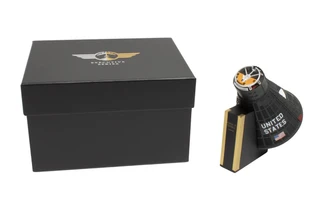
The Mercury Capsule at 1:24 scale captures the craft at genuine collector quality: hand-painted pressurized resin, a removable hatch that reveals the authentic interior layout, and a wooden display base. At roughly $250 it's one of the more accessible entry points into the Executive Series space lineup — though "accessible" is relative when the model itself is a serious museum-quality sculpture.
Gemini followed. Where Mercury was one person, Gemini was two — and where Mercury proved survival, Gemini proved capability. The program ran ten crewed missions between 1965 and 1966, teaching NASA how to rendezvous, how to dock, how to spacewalk, and how to keep astronauts alive on missions that lasted days rather than hours. Everything Apollo later did in lunar orbit was rehearsed first in Gemini.
Gemini IV is the specific mission that gets the Executive Series treatment — and it's the right choice. On June 3, 1965, Ed White opened the hatch of Gemini IV and floated out on a 23-foot gold-plated umbilical. It was the first American spacewalk, and the photograph — White suspended against the curve of the Earth, visor reflecting the Pacific — is one of the defining images of the 20th century. The model preserves the capsule's distinctive black-and-silver configuration at 1:24 scale with a wooden base.
Apollo 11: The Crown Jewel of Any Space Collection
No mission in human history has generated more collectibles than Apollo 11, and for good reason. On July 20, 1969, Neil Armstrong and Buzz Aldrin landed the Lunar Module Eagle on the Sea of Tranquility while Michael Collins orbited above in the Command Module Columbia. Four days later, Columbia splashed down in the Pacific with all three men and the lunar samples aboard. It remains the only portion of the Apollo 11 stack that returned to Earth, and it's now the centerpiece of the Smithsonian's "Milestones of Flight" gallery.
Executive Series offers three distinct ways to own Apollo 11:
The 1:25 scale Command Module is the detailed static replica — a cast-resin model of Columbia as it appears today, with heat-shield scorching, recovery hook points, and hatch detail faithfully reproduced. At just over $250 on sale it's the entry-level Apollo piece, and only five remain in stock at the time of writing.
The 1:30 Apollo 11 Floating Model is the showstopper — and this is where the Executive Series line gets genuinely surprising. Using magnetic levitation technology, the capsule hovers and rotates in mid-air above its base, mimicking the weightlessness of its actual lunar environment. The hatch is still removable; the interior detail is still there. It's $325 on sale, it ships in June 2026, and it's the most striking single piece in the current lineup.
For the collector who wants the full lunar-landing hardware together, the Apollo 11 Command & Lunar Modules Set pairs the CSM with the LEM at 1:48 scale — the two spacecraft that separated in lunar orbit, with the Eagle descending to Tranquility Base while Columbia orbited above. Having them side-by-side on a display shelf recreates the geometry of the actual mission. At $426 for the set, with only five in stock, it's the definitive Apollo 11 display piece.
The Rockets: From Redstone to SLS
Spacecraft are only half the story. None of these capsules, none of these orbiters, would ever have left the pad without the launch vehicles beneath them — and the Executive Series rocket lineup runs the full developmental arc from Mercury's Redstone to the current-day SLS.
The Mercury-Redstone Rocket at 1:72 scale is the starting point: a tall, slender rocket that launched Alan Shepard and Gus Grissom on their suborbital flights in 1961. The Redstone was derivative of the Army's Jupiter ballistic missile program — a reminder of how closely the early space race paralleled Cold War missile development. Only five are in stock.
Then there's the Saturn V — and we should talk about this one carefully, because it's the signature piece of any Apollo-focused display.
Standing 363 feet tall in real life, the Saturn V is the most powerful launch vehicle ever flown to operational status. From 1967 to 1973 it launched thirteen times, carrying every Apollo mission to lunar orbit as well as the Skylab space station. Not a single one failed to deliver its payload. The Executive Series 1:200 model stands 23 inches tall — nearly two feet — which means this isn't a shelf piece so much as a vertical architectural element for whatever room it goes in. The five F-1 engines at the base and the escape tower at the tip are both rendered in precise scale, and the whole thing sits on an integrated base.
At $325 on sale and in stock, it's arguably the single most important piece in the entire Executive Series catalog.
Fast-forward half a century and NASA's current heavy-lift vehicle is the Space Launch System (SLS), flying under the Artemis program. The SLS debuted on November 16, 2022 with the uncrewed Artemis I mission, sending an Orion capsule on a 25-day flight around the Moon. Its configuration — orange core stage flanked by twin five-segment solid rocket boosters — is directly derivative of the Space Shuttle stack, which makes it a visual successor to the shuttles in a way no other modern rocket is.
The 1:200 SLS model stands 22 inches tall with its base. It's in pre-order for June 2026 delivery at $325. For collectors building a display that spans the full American spaceflight era, putting the Saturn V and SLS side-by-side — the rocket that took us to the Moon and the rocket that's taking us back — is a genuinely satisfying geometric statement.
The Space Shuttle Era
Between the Apollo era and the Artemis era came the Space Shuttle — 135 missions over 30 years, built and lost five orbiters, carried every component of the International Space Station into orbit. The shuttle program is the longest-running and most operationally complex American crewed program to date, and it arguably did more to establish routine human presence in space than anything before or since.
Executive Series offers the three surviving flight-capable orbiters — Discovery, Atlantis, and Endeavour — in two forms: individual "full stack" models showing each orbiter mated to its external tank and solid rocket boosters in launch configuration, or the trio together in a collector's set.
Discovery was the fleet leader. Thirty-nine missions — more than any other spacecraft in history. It deployed the Hubble Space Telescope in 1990, carried John Glenn back to space at age 77, and flew the "Return to Flight" missions after both the Challenger and Columbia losses. It's now on permanent display at the Smithsonian's Udvar-Hazy Center near Dulles.
Atlantis flew the final Space Shuttle mission, STS-135, in July 2011. It was the primary workhorse for International Space Station assembly and flew the final Hubble servicing mission (SM4) in 2009. It's now at the Kennedy Space Center Visitor Complex in Florida.
Endeavour was the youngest of the fleet — built from structural spares to replace Challenger after the 1986 loss. It performed the first Hubble servicing mission in 1993, which corrected the telescope's famously flawed primary mirror. Endeavour is now at the California Science Center in Los Angeles.
All three full-stack models are 1:200 scale, $280 on sale, and in pre-order for near-term delivery. Each captures the orbiter mated to the external tank and twin SRBs in launch-ready configuration — the geometry that defined 30 years of American spaceflight.
For collectors who want all three orbiters together, the Space Shuttle Collection packages Discovery, Atlantis, and Endeavour as a matched trio — each on its own polished wooden base, rendered at 1:200 scale in their on-orbit configurations (without the launch stack). At $360 on sale for the set, with only two sets remaining in stock, it's the most efficient way to own all three orbiters simultaneously.
2. Military & Strategic Aircraft
The military portion of the Executive Series lineup runs across three generations of American airpower: the variable-sweep Cold War icons, the stealth revolution of the 1980s and 90s, and the fifth-generation fighters currently defining modern air combat. Seven aircraft, each of which represents a distinct moment in the evolution of combat aviation.
Fifth-Generation Stealth: F-22 Raptor & F-35 Lightning II
Fifth-generation fighters are defined by four traits: all-aspect stealth, integrated avionics, supercruise capability, and networked sensor fusion. Only a handful of aircraft worldwide meet that definition, and two of them are American: the F-22 Raptor and the F-35 Lightning II.
The F-22 Raptor at 1:48 scale is the apex air-superiority fighter — designed from the ground up to be invisible on radar until it's already too late. Its twin thrust-vectoring nozzles give it post-stall maneuverability no other operational fighter can match, and its supercruise capability lets it sustain supersonic flight without afterburner. The Air Force built only 187 of them before production ended in 2011, which makes the Raptor one of the rarest combat aircraft in active service.
The Executive Series model measures over 15 inches long in pressurized resin, with the faceted stealth geometry and distinctive canted twin tails fully rendered. It ships in June 2026 at $280 on sale.
Where the Raptor is specialized for air dominance, the F-35A Lightning II is multi-role — a strike fighter designed to be procured and operated in massive numbers across the Air Force, Navy, Marine Corps, and a dozen allied nations. The F-35 program is the most expensive weapons program in history, and the aircraft itself is arguably the most consequential Western combat platform of the 21st century.
Executive Series offers the F-35A in two different squadron liveries, letting collectors display them in formation:
Both are 1:48 scale, $180 on sale, and ship in June 2026. At that price point — dramatically lower than the other stealth aircraft in the lineup — the F-35 is the most accessible entry into Executive Series military modeling.
Cold War Legends: F-14, SR-71, B-2
Three aircraft from the Cold War era anchor the strategic end of the lineup, and each one represents a different answer to a different question about how to project American airpower.
Start with the F-14D Tomcat in the famous VF-84 'Jolly Rogers' livery. The F-14 was the Navy's answer to the question of fleet air defense: a two-crew, variable-sweep-wing interceptor capable of engaging Soviet bombers at long range before they could launch anti-ship missiles. It carried the AIM-54 Phoenix missile — at the time, the longest-range air-to-air weapon in the world — and its variable-geometry wings allowed it to land on carrier decks at low speed and dash at supersonic speeds in the same mission.
The VF-84 "Jolly Rogers" livery — high-visibility yellow-and-black skull-and-crossbones on a gloss dark-blue airframe — is arguably the most recognizable squadron paint scheme in naval aviation history. It's the livery that appeared in The Final Countdown (1980), and it's been worn by different squadrons (VF-61, VF-84, VF-103, now VFA-103) since the Second World War. The Executive Series 1:48 model captures the "D" variant — the final and most capable Tomcat configuration — with the iconic livery fully rendered. June 2026 delivery at $326.
Then there's the aircraft that arguably has no peer in aviation history: the SR-71 Blackbird. Built by Lockheed's Skunk Works under Kelly Johnson in the early 1960s, the Blackbird was designed to do one thing — fly faster and higher than anything that could shoot it down. It achieved that so completely that in 32 years of operational service, not a single SR-71 was ever lost to enemy action. Its standard tactic when detected was simply to accelerate. Over Mach 3, at 85,000 feet, there was nothing the Soviet Union or anyone else could put in the air to catch it.
The titanium airframe heated to over 600°F in flight. The fuel expanded so much at cruise that the aircraft literally leaked on the ground — the panels were designed to seal only once the metal expanded at temperature. Every aspect of the SR-71 was an engineering compromise pushed to an extreme that no other aircraft has matched before or since. It remains the benchmark for speed in the air-breathing manned-aircraft category.
The Executive Series Blackbird is 18 inches long in pressurized resin, with the long needle fuselage and the massive J58 engine nacelles rendered to scale. It's in pre-order for April 2026 delivery at $280.
Rounding out the strategic trio is the B-2 Spirit stealth bomber. Developed by Northrop Grumman in the 1980s and deployed in 1997, the B-2 remains the only operational flying-wing bomber in the world. Its 172-foot wingspan and radar-absorbent composite skin give it the ability to penetrate sophisticated air-defense networks and deliver payloads anywhere on Earth with minimal refueling. The Air Force operates only 20 of them — each valued at over two billion dollars, which makes the B-2 the most expensive aircraft per unit ever produced.
The 1:100 Executive Series model has a 20.5-inch wingspan — it's the widest aircraft in the lineup by a significant margin, and it requires real shelf real estate to display properly. May 2026 delivery at $280 on sale.
The Heavy Lifter: C-17 Globemaster III
If fighters are the glamorous end of military aviation, airlifters are the unglamorous workhorses that actually win wars. The C-17 Globemaster III is the standard strategic airlifter of the U.S. Air Force and about a dozen allied air arms — and it's arguably the most operationally important aircraft on that entire list.
A single C-17 can carry a 70-ton M1 Abrams tank, or 102 combat-loaded paratroopers, or an entire medical evacuation hospital. It can take off from a 3,500-foot unpaved runway and land with the same load on the same surface. It has carried every president's limousine and security detail since its introduction, and it's been the primary vehicle for American humanitarian response from the 2004 Indian Ocean tsunami to the 2021 Afghanistan evacuation.
The Executive Series C-17 at 1:100 scale is substantial: 21 inches long with a 20-inch wingspan, cast in pressurized resin with a polished wooden base. At $320 on sale — reduced from $400 — it represents one of the larger single markdowns in the current lineup. Only one remains in stock at the time of writing.
3. Business Aviation: The Bombardier Global 6000
The final category in the Executive Series lineup contains a single model, but it's a significant one. The Bombardier Global 6000 is one of the definitive long-range business jets of the 21st century — a large-cabin, ultra-long-range platform with a 6,000-nautical-mile range and enough cabin volume to operate as a genuine mobile office.
The Global 6000 is the platform of choice for Fortune 500 fleet operators, heads of state, and high-net-worth individuals requiring truly intercontinental reach. Its closest competitors are the Gulfstream G550/G650 family and the Dassault Falcon 7X — which puts it in rarefied company.
The Executive Series 1:55 scale model is 21 inches long — deliberately sized for boardroom or executive-office display. Cast in pressurized resin with a polished base, it's the kind of object that belongs on the credenza behind the desk of someone who actually operates aircraft in that class. At $400 on sale, with five in stock, it's the natural centerpiece for any business-aviation-themed display.
What to Look For When Buying Executive Series Models
A few notes for collectors new to the Executive Series line, or deciding between pieces:
Material matters. Executive Series uses cast-molded pressurized resin, not plastic or diecast metal. The trade-off is weight and finish: resin holds fine detail better than injection-molded plastic and produces a substantial, hand-finished feel that's closer to sculpture than toy. It's also more fragile — these are display pieces, not play pieces.
Scale determines display footprint. The smallest models in this lineup (the 1:200 space vehicles) still measure 7 to 23 inches in their longest dimension. The largest (the 1:48 fighters and 1:55 business jet, the 1:100 C-17) require real shelf space — measure before you buy. The C-17 and B-2 both need at least 22 inches of clear horizontal display area.
Pre-order vs. in-stock matters for timing. Roughly half the current lineup is in pre-order status with June 2026 delivery windows. That's normal for Executive Series — the manufacturer produces in small batches and ships on published schedules. Locking in a pre-order secures your unit before the batch allocation closes.
Scarcity is real. Several pieces in the current lineup are down to single-digit stock counts — the C-17 is at one unit, the Shuttle Collection at two, and multiple others at five. When Executive Series models sell through, they don't always return; production decisions are made batch-by-batch.
Bases are included. Every model in this guide ships with its display base — wooden for most of the space program pieces and the C-17, metal display stands for the military fighters, and an integrated base for the Saturn V. There are no additional purchases required to display a model properly.
Browse the Complete Collection
The twenty pieces covered in this guide represent the current Executive Series lineup at Diecast Airplane Store. Stock is live on the website; pricing reflects current promotional markdowns from MSRP. If you're building a themed display — a full-spectrum space program shelf, a stealth-aircraft formation, a business aviation desk piece — the category page is the most efficient way to see everything at once.
For questions about sizing, pre-order timing, or piece-specific details, the product pages linked throughout this guide include full specifications, dimensions, and stock counts. Our team is also available by phone at 888-475-1533.